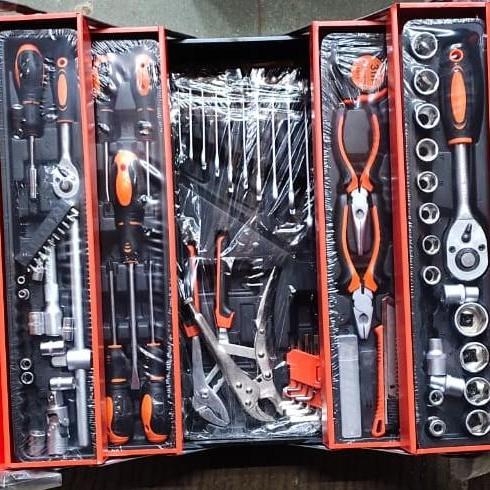
We Mehta Textile Trading co are dealing in wholesale tools including imported garage tools.
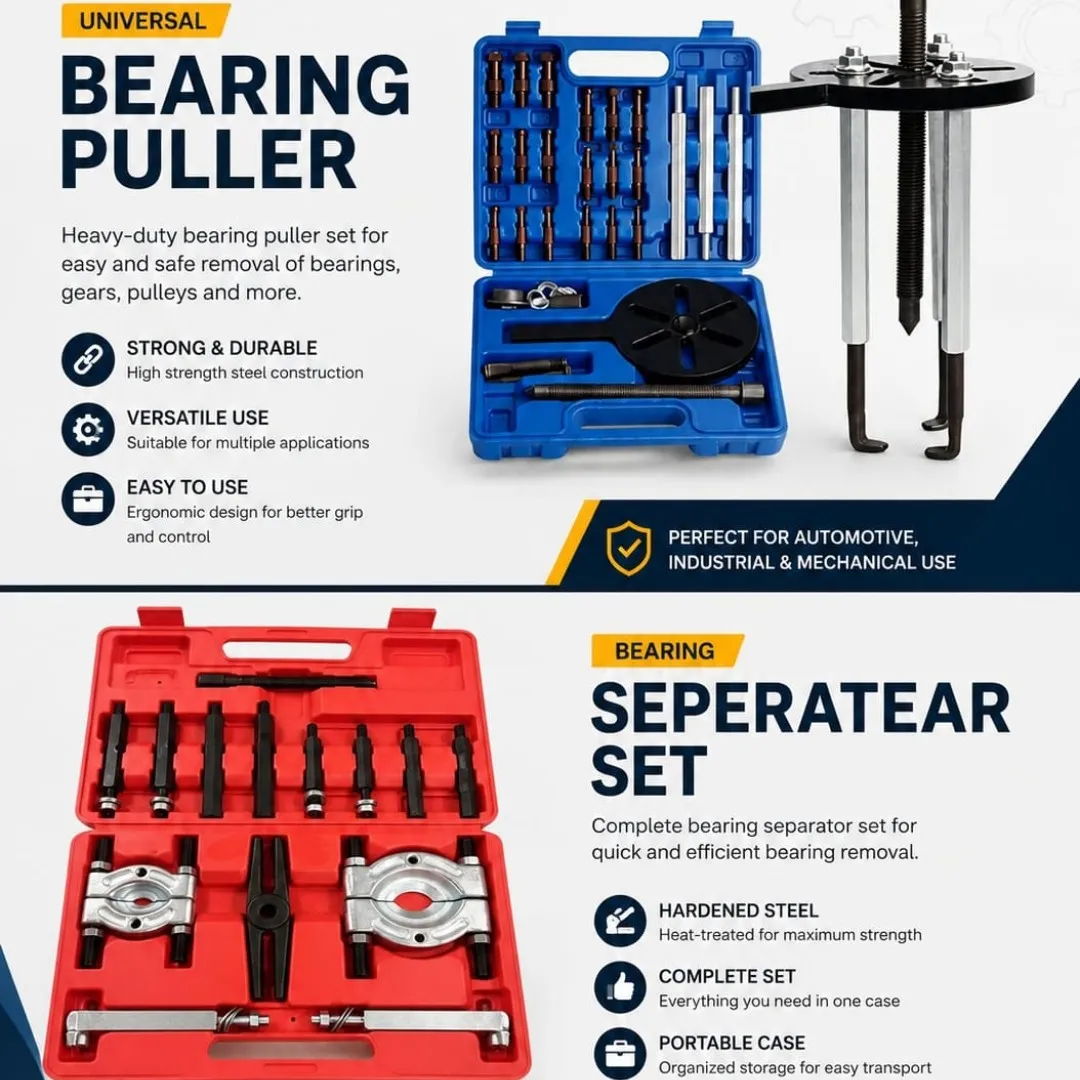
Both Universal Bearing Pullers and Bearing Separators are designed to safely damage-free extract tightly fitted components, but they operate differently and are used in distinct scenarios.
1. Universal Bearing Puller
A universal bearing puller is a versatile tool featuring adjustable jaws (typically 2 or 3) and a central forcing screw. It uses mechanical force to grip the outer or inner edge of a component and pull it off a shaft.
How it Works
- The Setup: The jaws grip the outside (or inside) of the bearing, while the central forcing screw is placed against the center of the shaft.
- The Extraction: As you turn the forcing screw with a wrench or ratchet, it pushes against the shaft, forcing the jaws to pull the bearing outward.
Key Types
- 2-Jaw Pullers: Best for tight spaces where clearance is limited on the sides.
- 3-Jaw Pullers: The preferred choice whenever possible because they distribute the pulling force more evenly (120^\circ apart), preventing the bearing from binding or tilting on the shaft.
- Internal vs. External: Many universal pullers have reversible jaws, allowing them to grip an external edge or reach inside a bore to pull from an internal lip.
Best Used For
- Pulling gears, pulleys, sprockets, and bearings that have an exposed lip or edge for the jaws to grab.
- Situations where there is sufficient clearance behind the component for the puller hooks to slide into.
2. Bearing Separator (Splitter)
A bearing separator consists of two halves with sharp, wedge-like edges that are bolted together. It is specifically designed for situations where a standard jaw puller cannot fit.
How it Works
- The Setup: The two halves are placed behind the bearing. As the side nuts are tightened evenly, the tapered, knife-like edges wedge themselves behind the bearing, gripping its back face.
- The Extraction: Because the separator itself doesn't have a pushing screw, it features threaded holes on its face. You attach long puller rods and a cross-beam (often called a yoke) to it. Turning the central screw of the yoke then pulls the separator—and the bearing trapped in it—off the shaft.
Best Used For
- Zero-clearance jobs: When a bearing is pressed completely flush against a housing, shoulder, or another gear, leaving absolutely no room for standard puller jaws to get a grip.
- Fragile components: The large flat surface area of the separator halves distributes the force evenly around the entire circumference of the bearing, minimizing the risk of cracking the bearing race.
#mehtatextiletradingco #toolswholesaler #dariyapur #ahmedabad
#ozartoolsdistributor #garagetools
#handtools #pneumatictools #cordlesstools #powertools #yatotoolsdealer
Keywords